Amplifying the music, books, movies and journalism that matter.
Life is complicated and busy. Did you notice? Keeping up with the music, movies and books that fed your youthful imagination and conversations is harder than ever, but even more important. Here's the good news: there's never been more great new stuff. The challenge is to find it.
So here are my highly opinionated views on sounds, sights and words that will help you keep it fresh and real, and links to the veins where the richest motherlodes can be found.
My first introduction to Luna, was their 1994 release Bewitched, played in nearly endless rotation on WXPN that year. Droning like some lost, less-thrashy version of the Velvet Underground, their
influences were crystal clear even without Sterling Morrison sitting in. For me, it was the beginning of a beautiful relationship and I followed them through the end of the CD era until they wrapped up in 2006. The VU always had a sweeter, pop side (think "Who Loves the Sun?"), and no one captured that essence better than Luna.
I was just starting to miss Luna when along comes Real Estate, their New Jersey heirs. On their last disc Days (a 2011 "Best" for me), their debt to Luna wasn't entirely clear, but their latest, Atlas, plays like a set of lost tracks from the "Bewitched" sessions, with an extra dose of the Ventures and Bob Welch-era Fleetwood Mac. Chiming guitars, metronomic drumming and reverb-muffled vocals -- it's perfect.
No one would have ever called Luna (never mind the Velvets) by the current label "dream pop," but that's what Real Estate gets tagged with. Don't let it put you off; this is lo-fi pop at its very best. See if you aren't hooked by "Talking Backwards":
Taut and nervous, cynical and defiant, They Want My Soul is one of the sharpest sounds of the year. Straight outa Texas, Spoon makes music that for me recalls the smart, angry young men of the British New Wave: Costello, Lowe, Jackson and Sumner (a.k.a. Sting). They and their bands covered a lot of territory, with politics, pain and posturing prominent topics. Their music was rarely the gentle place you went for sodden consolation. Spoon serves up the same jangled energy, the same refusal to mope. This is music about taking action.
On this their eighth album, they are working with some big ideas: who owns our essence? This from the title track "They Want My Soul":
Card sharks and street preachers want my soul
All the sellers and palm readers want my soul
Post sermon socialites
Park enchanters and skin tights
All they want's my soul
Or on "Do You", where the question is what we're looking for:
Do you want to get understood?
Do you want one thing or are you looking for sainthood?
Do you run when it's just getting good?
Or do you, do you, do you, do you...
This is music about how we meet the world when we are young. Some of us need a good long drink of it to recall the taste. It may burn a little going down, but it will warm you up.
For boomers of a certain age, the reggae section of your record shelf (and it was LPs on a shelf), was not a big space. Everybody had a copy of "The Harder They Come" 1972 soundtrack. A Bob Marley album surely, probably 1973's "Natty Dread " or "Legend," the 80's compilation. The likely third in the trifecta was Toots and the Maytalls' 1972 "Funky Kingston," a frat house fav.
I had 'em all. And I won't pretend my reggae shelf was much deeper either. Oh sure, I had much loved copies of Linton Kwesi Johnson's "Forces of Victory" and Dennis Bovell's "Brain Damage," both cherished finds discovered from a NY Times year-end best list in the late 70's (from the "other" Robert Palmer or John Rockwell, I would suppose). But these were documents of reggae morphing into dub and the other styles that followed.
Jamaican reggae was a music that changed the soundscape of popular music -- opened it up to non-American sounds -- and to suppose that Marley, Toots and Cliff did that themselves is a colossal misreading. So I recently went looking for the other reggae classics of that era, now called "roots reggae." And boy, what a treasure trove I found!
The Congos, Heart of the Congo
Recorded in 1977, this disc is full of songs that would have sounded right at home on "Harder." Think of the the Congos as "The Miracles" of roots reggae. No Smokey Robinson here; that was Marley's job, but you will find the consistency and adultness the Miracles as an ensemble. This is beautiful soul music steeped in the Caribbean, and iPod-ready for your next island sojourn or jerk chicken dinner.
Junior Murin, Police and Thieves
Like the lead for the Congos, Murin sings up there in the falsetto register. " 'Sup with that?" I thought, until I realized that this is a vocal style straight out of 60's R&B, which is what was playing on the radio in Kingston, too. This music is a little tougher than the Congos, and pulls on the threads of rock steady, the reggae precursor. Murin writes and sings about a world gone wrong, a Jamaica that is no island paradise, which would make sense by 1977 when Manley was struggling to keep the country together.
Black Uhuru, Red
I remember seeing Black Uhuru discs in the reggae bin in the early 80's and passing them by. What a dope. BU is reggae getting angrier, harder, global. There are several eras of BU music and "Red" from 1981 is about as late as you can get and still call it "roots." Rolling Stone rated this #23 in the top albums of the '80's. And I still didn't pay attention. I'm listening now, though.
The Wailers, Catch a Fire
Maybe this was your Marley album -- the Wailers' first Island release in 1973 after Johnny Nash split -- but I didn't catch this train until later. And looking back on it now, it's clear that it was a masterpiece, the place where Marley's sound takes vivid form. Listen, really listen to the rhythm guitar snaking through Concrete Jungle; if it sounds like it could have been straight out of Muscle Shoals, it's because it was.
The Might Diamonds, The Right Time
I saved the best for last. This gem from 1976 was the debut for these guys and was, I learn now, hugely popular in Jamaica. Small wonder. It moves along like an unstoppable train. But its obscurity continues nearly forty years later despite its critical acclaim. Pop Matters calls this one of "Five Reggae Albums You Cannot Live Without." Yet you'll find this nowhere on iTunes. Instead, round up a CD copy on Amazon and rip it right into your library.
I wish I could say I was the hip guy spinning this stuff in between cuts from the Clash and the Police at our Lost Boys parties in 1980. But I sure am glad I can drop them in now.
Three months? Boy, I have some catching up to do. So first off, here are three songs that keep bringing me up short when they pop up on my playlists, each fooling with -- and merging -- country and rock traditions.
Peter Wolf, Nothing But the Wheel
Peter Wolf? Mr. "Whammer Jammer, let me hear you Dickey"? Same guy, long past his J. Geils gig. Still making music -- better now if you ask me -- including this gem from his "Sleepless." And yes, that's Mick Jagger singing backup in his best "Sweet Virginia" drawl with Waylon Jennings thrown in for good measure.
John Doe and the Sadies, Are the Good Times Really Over For Good
Doe, the frontman for the classic Los Angles punk band X, is a country traditionalist who gave that band it's uniquely American edge. He's still recording great music like this ironic number that has Merle Haggard written all over it.
Dwight Yoakum, Heart Like Mine
If you heard this tune streaming out of a roadhouse somewhere when you drove into the parking lot, you'd go right in. A Bakersfield tune with a classic rock fake fadeout -- you think it's over and then it comes back. It's a goddam rockabilly Helter Skelter. (You can thank producer Beck Hansen for that touch.)
Who would have thought that the one-name guy who gave us the jokey, brainworm "Loser" in 1994 or a couple of years later, the paen to hipsterism "Where It's At" ("two turntables and a microphone"), would twenty years later produce a reflective, hypnotic adult pop album for the ages?
Morning Phase is the name of this surprise from Beck. It is -- without hyperbole -- a masterpiece of the kind that come along once in a decade or so. Texturally unified (and beautifully so), it sets the kind of spellbinding mood that was conjured by Roxy Music's Avalon, Mitchell's Heijera, U2's Joshua Tree orWilco's Sky Blue Sky without sounding like any of them.Pink Moon, anyone?
In a world full of hard, angular hip-hop, this is beautiful music. Slowed down, full of string washes with occasional bluegrass-y fills, Morning Phase is music about the start of something -- a new day, adulthood, life after a dark time. Like all such beginnings, it's not clear what will follow and there is a tone of apprehension and dread to some of these songs. But the musical mood it sets is one of relief: "thank God that's over."
Listen to "Blue Moon" and "Say Goodbye," two tracks that show the range of the album:
Morning Phase is the kind of work has made me keep faith with pop music and its endless ability to surprise and satisfy.
I can still remember hearing the sound of dub for the first time in 1980 on the Clash's Sandinista. It was a gateway drug that led me straight to Linton Kwesi Johnson's Forces of Victory and Dennis Bovell's Brain Damage. And then, of course, I recognized how much its sound had influenced everyone from Culture Club to the Police, all of whom had been soaking in the work of reggae geniuses like King Tubby and Lee "Scratch" Perry through the 70's. Dub was a reggae beat slowed down and opened up with reverb and echo. It was a musical rebuke to Margaret Thatcher.
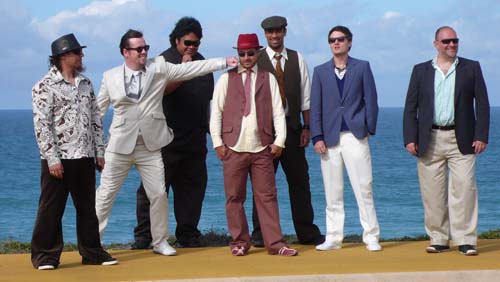
But who would have thought that more than three decades later this beat would animate Wellington, New Zealand's Fat Freddy's Drop, a self-described "seven headed soul monster"? Their Blackbird is a a gumbo of soulful horns, organ, and swampy rhythm guitar that could have easily have been Sly Stone's follow-up to Fresh (if he had gone to Kingston and gotten his shit together).
So forget that it's from way down down under and sample Fat Freddy's Drop and their "Blackbird." Time to get wise.
As the year starts with the snow swirling, I can't get enough of a 2013 disk that came to me via WSJ critic Jim Fusilli's year end column (he's a very reliable guide, but that's a subject for another post).
The album is Feeling Good by the West Yorkshire trip-hop team, Nightmares on Wax. Built around DJ George Evelyn, NoW is now in most ways a performing band but with the roots of its mixmaster boss. Evelyn has a deep feel for the soul sounds he was raised on: Mayfield, Marley and Motown all show through. His pedigree as a producer includes work with De La Soul in the early aughts.
Can I find superlatives enough? No, I cannot. Feeling Good is the equal of the best work of Massive Attack and Groove Armada, steeped in dub and reggae, classic soul and ambient sounds. The other night at my house, it had the whole room quietly pulsing -- twenty-somethings to fifty-somethings --and no one said, "Can you turn this down?"
CHECK THIS OUT: NoW kicking "Be, I Do" and then think, "Gee, if every track is as good as this this, shouldn't Feeling Good be playing in my ears/car/party right now?"